Building on Rubble: Earthquake Recovery
FRED DE SAM LAZARO: Kashmir’s vast landscape is textured with the rubble of collapsed buildings, of mountains reshaped by landslides, the fresh graves of 73,000 quake victims and precarious tents for the millions who survived.
This field clinic in the remote village of Katai was set up by a group of Pakistani American doctors. Patients come in by the hundreds. The elderly —
SPOKESMAN: Osteoporosis…
FRED DE SAM LAZARO: The young, a baby with a massive ear infection.
Two months after the earthquake, patients are now coming in with chronic long untended illnesses, consequences of poverty more than an earthquake.
But there are still many earthquake victims like this Mansur Kiani.
MANSUR KIANI (Translated): A beam fell on my leg. I was trapped in my shop for four days.
FRED DE SAM LAZARO: His wound has been slow to heal, and there’s little anesthesia. It’s a metaphor for the whole region. The waiting area outside is filled with anguished stories.
INTERPRETER: Actually she has lost the little land that she owned because of the landslide. She lost her husband, her son, her daughter-in-law.
FRED DE SAM LAZARO: There’s been little time to ponder grief here. Survival takes precedence.
In Katai, the doctors’ group has dispensed tents and food. There’s never enough to go around.
RYAN CROCKER, U.S. Ambassador: It remains an acute crisis, an acute disaster. It’s been that since the day of the quake, Oct. 8, and I believe it will continue to be that right through the winter.
FRED DE SAM LAZARO: U.S. Ambassador Ryan Crocker notes this is one of the world’s most militarized areas, bitterly fought over and divided between India and Pakistan.
Today Pakistan’s military has turned its prowess to relief work, aided by many international teams.
Pakistan may be a poor country but it does have a substantial middle class and a large overseas population, among them, 10,000 doctors who practice in the United States and Canada.
The doctors’ group has raised millions in cash, medicines and equipment. Dozens of Pakistani American physicians like this Fareed Sheikh have spent time here bringing much needed medical and language skills.
Cardiologist Abdul Rashid Piracha is president of the Association of Pakistani Physicians in North America.
DR. ABDUL RASHID PIRACHA: The attitude or the passion that our members have shown in this earthquake is just beyond description. We as an organization are hoping that any aid that comes from the U.S.A., that people, experts like ourselves, have some watchful eye on it as to where it is spent and whether it is spent properly or not.
FRED DE SAM LAZARO: The group wants to be a watchdog not only against corruption but also to make sure aid pledges are collected.
Dr. Saeed Akhtar is a surgeon who moved back to Pakistan after years in Texas.
DR. SAEED AKHTAR: People who have pledged real big bucks to the country in forms of pledges probably will not come through. We need to sort of — I hope I’m wrong. But, you know, the experience tells that’s what it is. And then if you start —
FRED DE SAM LAZARO: That means people pledge but don’t actually deliver on it?
DR. SAEED AKHTAR: That is exactly right. Just the examples are in front of us. Tsunami was not too far away. Only one third of the money that has been pledged for the tsunami has been collected so far. It’s a year out now.
RYAN CROCKER: We’re conscious of the tsunami experience. And we will not only ensure that we do what we said, we’re going to do our level best to ensure that others do the same thing.
FRED DE SAM LAZARO: And come through with their pledges.
RYAN CROCKER: Exactly.
FRED DE SAM LAZARO: The U.S. has pledged $510 million to the Pakistani relief effort. Ambassador Crocker said it’s not only the right humanitarian thing to do but it is also important symbolically.
RYAN CROCKER: Pakistan is the second most populous Muslim country in the world. It’s important, I think, as we consider our relations with the Muslim world that we consider how we can make a difference by come to go the aid of Muslims who have suffered.
FRED DE SAM LAZARO: American Chinook helicopters have been key to shuttling relief supplies and casualties. Many of them arrive at one of two U.S. military mash units.
This one has become a key medical center for Muzaffrabad, the regional capital. Its hospitals were wiped out in the quake.
For patients, there’s a stark reminder that winter is here, also that this is a theater in the war on terror. No one escapes the metal detector. Some 11,000 patients have come through the two mash units. Today many of their ailments reflect the quake’s legacy: Orthopedic care, tent fires and accidents from the struggle to survive.
Air Force physician Fareed Sheikh:
MAJ. FAREED SHEIKH: There’s a town called Bolicot; further beyond that where they live is a landing zone for the drop-off for the aid. And as the helicopter was landing, it basically — they have artificial tents that are both built from tin. It came lose, and she was standing and it struck her in her back.
FRED DE SAM LAZARO: The biggest fear now is that a harsh winter could threaten as many lives as the earthquake. Pakistan Army General Farooq Ahmed Khan is still trying to get sturdy shelter for everyone.
GEN. FAROOQ AHMED KHAN: About 500,000 houses were destroyed as per our estimate. As for the World Bank, it was over 400,000. So nevertheless, as of today, we have distributed about 675,000 tents but as you would know that most of these tents are ordinary tents.
FRED DE SAM LAZARO: Not winterized?
GEN. FAROOQ AHMED KHAN: Not winterized, So winterized is about 12 percent, which is a very small number
FRED DE SAM LAZARO: He says the army’s priority is to build simple one-room shelters for people living at elevations above 5,000 feet. Many of Kashmir’s fiercely independent mountain people chose to remain close to what property and livestock they could salvage. Gen. Farooq fears winter may force many to lower elevations.
GEN. FAROOQ AHMED KHAN: My biggest worry would be should the weather turn bad and the population decides to come down so we’ll have to have facilities to look after about 200,000 people.
FRED DE SAM LAZARO: Even now conditions are strained at lower elevations. Many surviving schoolchildren, some who 18,000 perished in the quake, have to study outdoors. Winter could bring their education to a close. Their families have tents, but little else.
NOOR JEHAN (Translated): There are ten people in this tent. The kids have no shoes, no clothes. It’s cold in the tent. We sleep close together under a quilt. We don’t have a heater or anything like that. The children are getting sick.
FRED DE SAM LAZARO: Noor Jehan is the matriarch of this household live together in a joint family, a common tradition here.
Each day Noor Jehan’s son, Aurangzeb, and a neighbor trek up to their property, about a mile and a half away on almost vertical terrain.
There on the rubble, her oldest son, Aslam, stays in a tent provided by the government. “We had three buildings here,” he says. “They all collapsed.”
MOHAMMED ASLAM (Translated): My wife was standing here. She was washing dishes when the building collapsed. She was thrown down the mountainside and she died. My son here, I was able to pull him out.
FRED DE SAM LAZARO: In all nine members of this extended family died. Their graves are about the only ones intact in the cemetery just across the street.
MOHAMMED ASLAM (Translated): We’d love to bring the whole family back here but the graveyard has been destroyed, and that scares us. No one’s been by to fix it. The road is gone. It’s too dangerous.
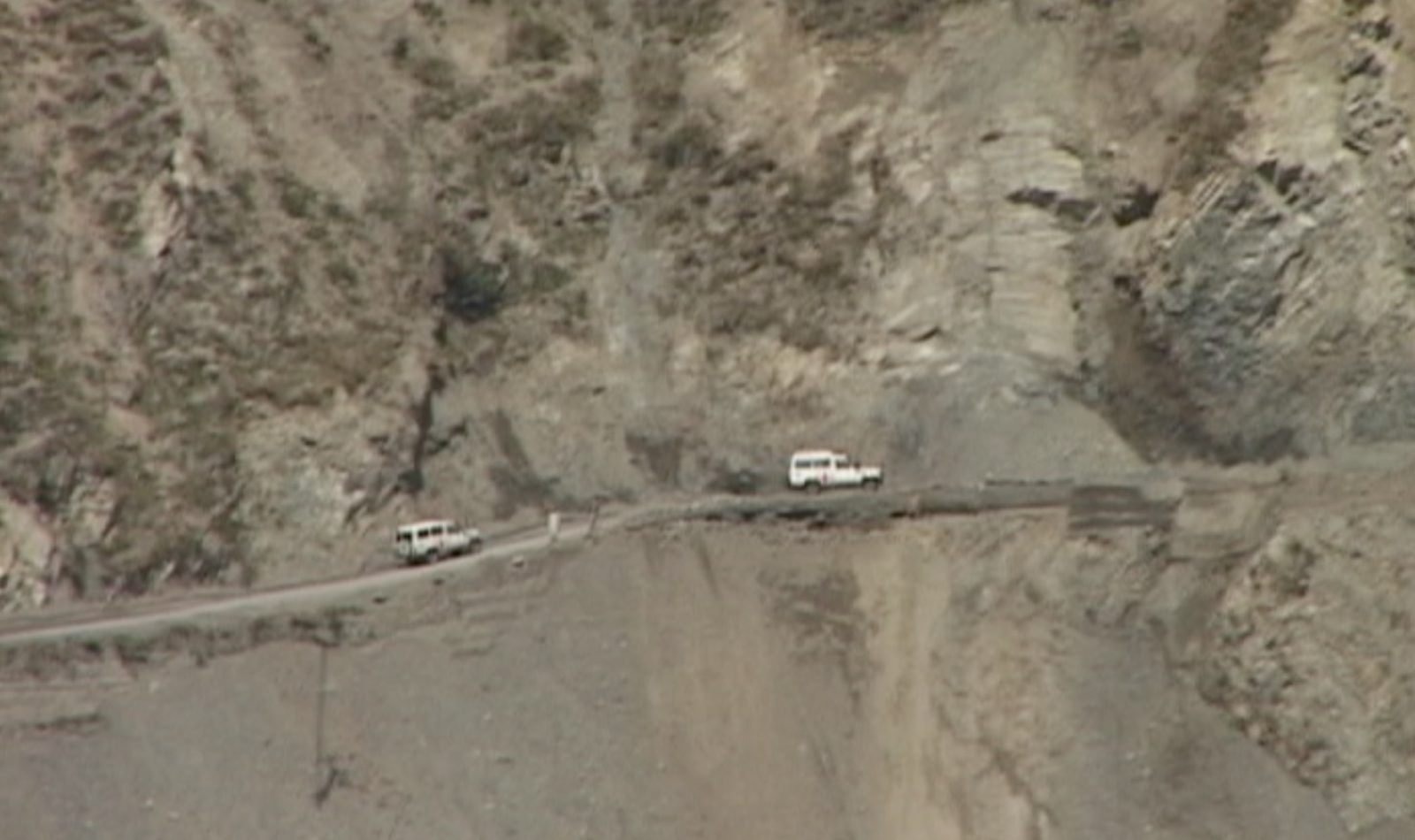
FRED DE SAM LAZARO: Much of the road leading to their home disappeared in the earthquake. It’s just one of hundreds of massive rebuilding projects this region will face for years. First, they must survive this winter.
JIM LEHRER: Ray Suarez has Part 2.
RAY SUAREZ: This Pakistan earthquake update comes from two officials of the organization Refugees International. A delegation from that advocacy organization spent five days in Pakistan in mid-December.
To discuss the mission we’re joined by Farooq Kathwari, chairman of Refugees International; he’s also the president and CEO of Ethan Allen Interiors. He grew up in the part of Kashmir controlled by Pakistan and is now an American citizen; and Kenneth Bacon, president of Refugees International and a former journalist and assistant secretary of defense in the Clinton administration.
RAY SUAREZ: Farooq Kathwari, you’ve just come back from the affected area. Tell us what you’ve seen.
FAROOQ KATHWARI: The tragedy is just enormous. I would just say that for me it’s too – anecdotes were important.
First was when we landed in Muzaffrabad, which is the capital of the Pakistan-administered Kashmir and the epicenter for the earthquake, about 70, 80 percent of the buildings are destroyed or structurally destroyed. There was chaos and destruction all over.
But in that chaos it was amazing to see the amount of cooperation among the Pakistan army, among the United States hospital that was there, the Turkish hospital, the Cuban hospital, and it was amazing to see the amount of cooperation that this crisis has brought about.
The second was when we met the prime minister, along with his major officials, and he said — he said, “I am now the prime minister of a graveyard.”
So that is really the two instances that to me gave the essence of what has taken place, this tragedy.
RAY SUAREZ: Now, Kenneth Bacon, the worldwide relief community watched in horror as the temperatures dropped; it was threatened that a lot of people were going to die from exposure; and as it turns out that wasn’t enough to make things just happen. There are a lot of people who are still out in the cold, aren’t there?
KENNETH BACON: There are, but I have to say that this has been an extraordinary relief effort under extremely difficult circumstances.
We all were appalled in the early days when we saw the devastation, people being dragged half-alive from buildings with their legs broken off, people undergoing surgery without any medication whatsoever.
A lot has happened since then and there is a huge humanitarian infrastructure there.
They started by reaching out to the people in the highest altitudes, above 5,000 feet. And they have done a very good job of getting blankets, tents, food, and winter provisions to these people.
Now, it’s still going to be a very tough winter; they’re still in very insubstantial shelters and tents. But they have reached most of these people — 15,000 separate communities and villages they had to reach by foot, by helicopter, and by truck, when they could. So they’ve done a much better job in the last month than they did in the first week
RAY SUAREZ: Mr. Kathwari, what do they still need to make it through this winter?
FAROOQ KATHWARI: Right now, the most important issue for them is the next three or four months. The winter is already there. They need shelter, especially for those who are still at higher altitudes.
Lots of people who live in these mountainous regions don’t want to give up their homes; that’s the only thing they possess. And also they don’t have the kind of deeds that we have over here, so they’re concerned that if they leave, that possibly they may lose their home.
So the challenge has been to take shelter to them. And that is taking place, but I believe that the world cannot forget that we could have a catastrophe in the next three or four months because now the challenge has just started; the winter has just started.
So I think there’s a tremendous amount of need for the next three or four months. And then of course the reconstruction starts; they have lost 80 to 90 percent of their educational facilities, many of the schools, their teachers have been killed; their main hospitals are destroyed. It was an amazing sight to see a five or six-story hospital come down one story, just the ground just gave in.
And today the students are in tents; the students have no facilities, so I think the most important thing is the world to understand that the crisis is not over; in fact, it is just beginning.
RAY SUAREZ: Well, Kenneth Bacon, the local government took a very interesting approach toward trying to jump-start the regional economy. Talk about what they did.
KENNETH BACON: Yes. Basically the Pakistani government made an almost immediate decision to pump cash into the pockets of the survivors. They did this in three ways.
They set up a very generous shelter compensation account. If you lost your house, you got almost immediately the equivalent of $400, which is a lot of money; this is a country where the per capita Gross Domestic Product is $2200 a year, so $440 is a lot of money. Eventually, though, everybody who lost a house will get a little over $3,000 — about $3100.
They have also paid people death benefits. If somebody in the immediate family died, you get up to about $2,000. And they also are compensating people for injuries. If you lost a limb, you would get about $1,000.
Now, there’s, of course, no way to put a price on death; there’s no way to put a price on a limb. But what this has done is give people a sense of confidence and a sense of independence. But it’s also made the recovery owner-driven. People who had houses got the money to repair those houses almost immediately.
RAY SUAREZ: Well, let me stop you right there. Once money is in your hands, does supply rise up to meet demand? Is there something to spend that money on?
KENNETH BACON: Well, in this case there has been. There’s been a huge effort to bring in corrugated iron roofing slabs. And these are shiny things that you put on the top of a house.
So the strategy has been — since most of the houses are built out of rocks and cement made from mud and some wooden beams, those rocks are still there, so they’ve used the beams and the rocks to reconstruct the walls of the house, and then they’ve put these corrugated sheets on top. So they’ve been able to reconstruct the houses very quickly.
Sometimes they will reconstruct — get the roof up — and build — set up a tent under the roof so they can live in that because the walls aren’t reconstructed yet.
But the fact of the matter is that we saw — one of the important aspects of monetizing aid is that it allows the economy to keep going and we saw markets that had risen from rubble. There were people selling building materials out of shops that didn’t have roofs themselves.
And so there is — the entire Pakistani steel industry is devoting its output now to producing these corrugated sheets so they can replace the roofs of lost houses. It’s really quite an extraordinary effort.
RAY SUAREZ: Farooq Kathwari, Kenneth Bacon, gentlemen, thank you both.
KENNETH BACON: Thank you.
FAROOQ KATHWARI: Thank you.
The Kashmir Region
The massive earthquake that hit Kashmir has devastated the region and killed an estimated 80,000 people. An estimated $6 billion in aid has been given to rebuild the infrastructure in the region. We report on the recovery efforts from the Pakistani controlled region of Kashmir.